


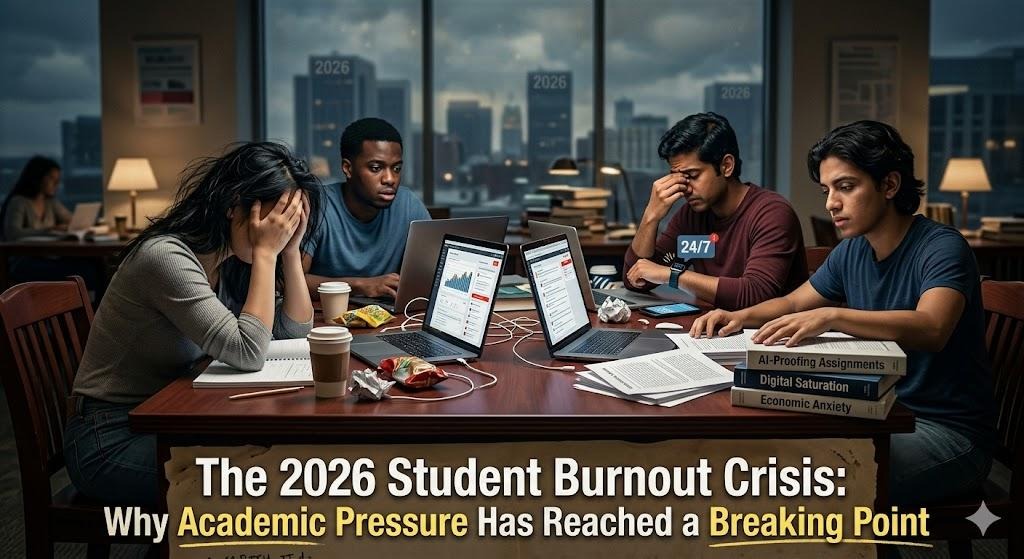
The image of the “carefree student” has become a historical relic, replaced by a generation navigating the most volatile educational landscape in a century. In 2026, walking onto a high school or college campus feels less like entering a sanctuary of learning and more like stepping into a high-pressure centrifuge. While previous generations dealt with term papers and social cliques, today’s students are navigating a complex convergence of technological hyper-acceleration, a volatile economic landscape, and a digital social structure that never sleeps.
If you feel like you are running a marathon with no finish line, you aren’t alone. Recent 2026 educational surveys indicate that over 68% of North American students report symptoms of chronic burnout before they even reach their sophomore year. As a Senior Content Manager and Academic Strategy Consultant, I have observed that the primary driver isn’t a lack of effort—it’s a system that has outpaced human bandwidth. Here is a deep dive into why student life in 2026 has reached a breaking point.
1. The “AI Arms Race” and Academic Integrity Anxiety
By 2026, Artificial Intelligence is no longer a novelty; it is the fundamental infrastructure of global education. However, instead of making life easier, it has effectively raised the ceiling of expectation. We are witnessing an “AI arms race” where the tools designed to assist are simultaneously creating a new layer of surveillance.
Proving “human” originality has become a secondary full-time job for students. With sophisticated AI-detection tools and institutional skepticism, students often feel they are under constant scrutiny. In 2026, AI anxiety in college isn’t just about getting caught using a bot; it’s the fear of a “false positive” ruining a hard-earned reputation. Furthermore, the bar for “excellence” has shifted. Since basic coding, drafting, and data analysis can be done in seconds by LLMs, professors now expect much higher-level critical thinking and “un-googleable” insights. For students struggling to meet these heightened technical standards, seeking professional data science assignment help has become a common strategy to bridge the gap between AI-generated drafts and the advanced analytical synthesis now required by top-tier universities.
2. Digital Saturation: The Death of the “Off” Switch
In 2026, the boundary between “school” and “home” has completely evaporated. With the ubiquity of hybrid learning models and persistent digital connectivity, students are expected to be reachable and productive 24/7. This is the era of digital saturation, where the physical classroom is merely one of many nodes in a student’s network.
The “hidden curriculum” of 2026 involves managing a relentless stream of notifications from Learning Management Systems (LMS) like Canvas or Blackboard, alongside group chats on Discord and Slack. There is no longer a physical departure from the classroom. When your desk is your bed and your classroom is a laptop, the brain never enters a state of true rest. This constant state of “readiness” is a primary driver of the chronic fatigue seen in high school and university students today. Even specialized tasks, such as visualizing complex datasets, add to the mental toll; many find that utilizing tableau assignment help is the only way to manage their time effectively when the digital workday never truly ends. Research into student productivity hacks for 2026 often misses the point: you cannot optimize a brain that is constantly “on.”
3. Economic “Pre-Game” Anxiety and Future-Proofing
Ten years ago, a student might start worrying about the job market in their senior year of college. In 2026, that anxiety has trickled down to the freshman year of high school. The global economy is shifting so rapidly due to automation and remote globalization that students feel they must “future-proof” themselves before they’ve even reached legal age.
There is a pervasive fear that choosing the wrong major or failing to secure a “Tier-1” internship by age 19 will lead to permanent economic displacement. This has turned education into a high-stakes transaction rather than a journey of discovery. Students are no longer asking “What do I want to learn?” but rather “What will survive the next wave of automation?” This shift from curiosity to survivalism is a quiet tragedy of the modern era.
4. The Social Media “Comparison Trap” 3.0
We are now well into the era of the “perfectly curated student.” On platforms like TikTok and Instagram, the “Study Web” aesthetic has created a standard that is impossible to maintain. Students aren’t just competing with their classmates; they are competing with influencers who post 5:00 AM “productive morning routines,” flawless digital notes, and a relentless “hustle culture” narrative.
This creates a psychological phenomenon known as relative deprivation. Even if a student is doing well, they feel they are falling behind because they aren’t “optimizing” every second of their existence. The social pressure to be a high-achiever, a social butterfly, and a physically fit influencer all at once is a recipe for burnout. In 2026, how to handle academic burnout must involve a radical de-coupling from the “aesthetic” of productivity.
5. Navigating Academic Complexity with Strategic Support
The curriculum itself has become more dense. As human knowledge expands, the amount of information packed into a standard semester has increased. In subjects like STEM, Data Science, and Advanced Linguistics, the foundations are moving targets. What was considered “advanced” in 2024 is now “introductory” in 2026.
Many students find that the traditional classroom setting isn’t enough to keep up with these accelerated standards. This is where external support becomes vital. For those struggling to bridge the gap between classroom lectures and high-stakes assignments, seeking professional assignment help has become a standard strategy for survival rather than a last resort. It’s about managing a workload that has statistically outpaced the number of hours available in a day. Utilizing reliable academic support systems is no longer about “taking the easy way out”—it is about high-level project management and ensuring that one difficult module doesn’t derail an entire semester.
6. The Loneliness Epidemic in a Hyper-Connected World
Paradoxically, while 2026 students are more “connected” than any generation in history, they report record levels of loneliness. Digital interactions have largely replaced the “third places” where students used to congregate—student lounges, cafes, and physical libraries.
Much of the collaborative work is now done through screens. While efficient, this lacks the emotional resonance of human connection. When you combine high pressure with low social support, the result is a mental health crisis. Students are navigating the hardest years of their lives behind a screen, often feeling like a cog in a digital machine rather than a member of a community. The impact of AI on student workload has also reduced the need for “study groups,” further isolating individuals in their own digital bubbles.
7. Environmental and Global Weight: The “Doomscrolling” Tax
Students in 2026 are the first generation to grow up with “Climate Anxiety” as a core part of their worldview. Unlike previous generations who viewed the future as a land of opportunity, many today’s students view the future as something to be survived.
This “doomscrolling” culture contributes to a sense of “Why bother?” that clashes violently with the “You must succeed!” pressure from parents and teachers. Reconciling the need to study for a chemistry exam with the news of global instability creates a state of cognitive dissonance that drains mental energy. This mental tax is rarely accounted for in traditional grading rubrics, yet it is a heavy burden carried by every student in the 2026–2027 academic cycle.
8. The Disappearance of “Soft Time”
“Soft time” is the unstructured time used for daydreaming, reflecting, and processing emotions. In 2026, soft time is extinct. Every gap in a student’s schedule is filled with “micro-productivity” or the reflexive pull of a smartphone. Without the ability to process what they are learning and experiencing, students are essentially “buffering.” They are taking in information faster than they can synthesize it. This leads to a feeling of being overwhelmed not just by the volume of work, but by the sheer volume of experience.
Strategy for Survival: How to Navigate 2026
While the challenges are unprecedented, they are not insurmountable. Survival in the modern educational era requires a shift in strategy:
- Prioritize Mental Hygiene: Just as you brush your teeth, you must “clean” your digital space. Unfollow accounts that trigger “productivity guilt” and set hard boundaries for notifications.
- Embrace Strategic Outsourcing: Recognize that you cannot do everything alone. Whether it’s forming a study group or using assignment help to master a difficult concept, asking for support is a sign of high-level time management.
- Focus on Durable Skills: Don’t just memorize facts that AI can recall. Focus on empathy, leadership, complex problem-solving, and ethics—skills that remain uniquely human.
- Reclaim “Boredom”: Allow yourself 20 minutes a day without a screen. Let your brain process the “data” of your life.
Frequently Asked Questions
Q.1 Why is student stress statistically higher in 2026 compared to 2020?
The increase is largely due to the “perpetual connectivity” model. In 2020, remote learning was a temporary disruption; in 2026, it is a permanent integration. The lack of a physical “end” to the school day, combined with the pressure to out-perform AI, has created a cognitive load that previous generations simply didn’t face.
Q.2 Is using professional assignment help considered “cheating” in the AI era?
In 2026, the definition of academic support has evolved. Using reputable services for guidance, structuring, and mastering complex concepts is increasingly viewed as strategic outsourcing—a professional skill used by top executives. As long as the final submission reflects the student’s own understanding and adheres to institutional policies, it is a tool for workload management.
Q.3 How can I protect my work from “false positive” AI detection?
Maintaining a “paper trail” of your drafting process is essential. Keep earlier versions of your work, research notes, and outlines. If a detection tool flags your original work, these artifacts serve as proof of human authorship.
Q.4 What are the most important “future-proof” skills for students today?
While technical literacy is a baseline, the most durable skills are “soft” skills: emotional intelligence, ethical reasoning, and the ability to synthesize information from disparate fields. These are areas where human intuition still vastly outperforms Agentic AI.
Conclusion
Student life in 2026 is an extreme sport. The combination of technological upheaval, economic instability, and digital exhaustion has created an environment where “feeling overwhelmed” is the default setting. However, by acknowledging that the system—not the student—is what’s broken, we can begin to find healthier ways to navigate it.
Education should be a ladder to a better life, not a weight that holds you underwater. It is time we start valuing student well-being as much as we value GPAs and test scores. If you are feeling the weight of 2026, remember: it’s okay to slow down, it’s okay to ask for help, and it’s okay to define success on your own terms.
About the Author:
Drake Miller is a senior content manager and academic strategy consultant with over 12 years of experience in the higher education and digital content sectors. He specializes in helping students navigate the intersection of emerging technology, such as Agentic AI, and traditional academic excellence. Drake is a passionate advocate for AI literacy and a dedicated supporter of Arsenal FC.