


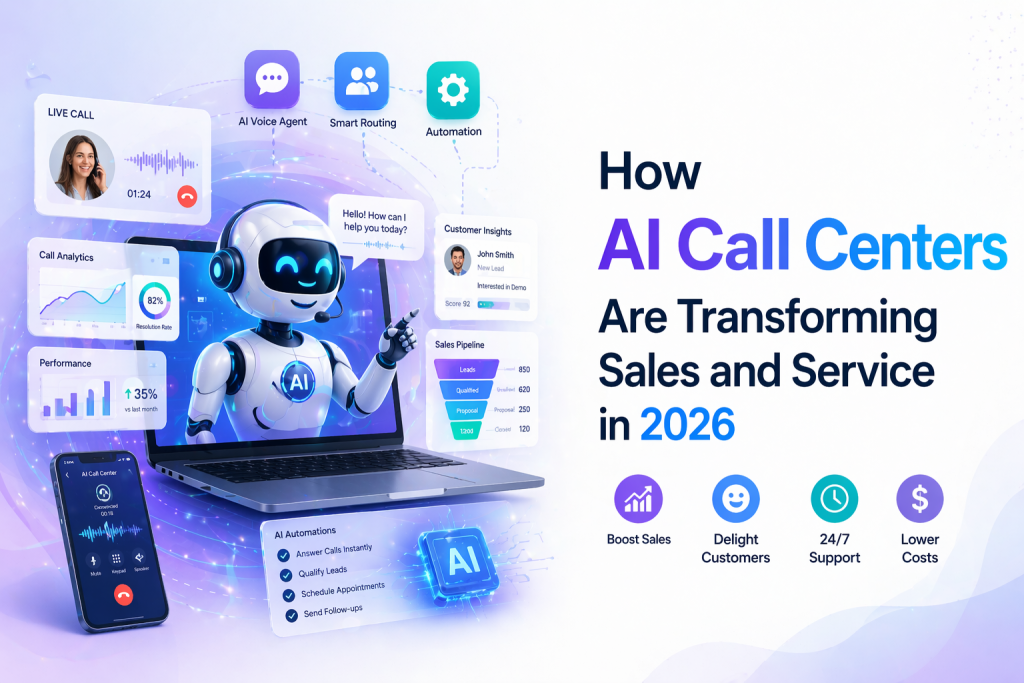
Here is a number that should stop you in your tracks: a human agent costs between $7 and $12 per call. An AI voice agent handles the same call for $0.40. That is not a marginal improvement that is a structural shift in how businesses communicate with customers, and it is happening right now.
Gartner projects that AI will save the global contact center industry $80 billion in labor costs by the end of 2026. The global call center AI market, valued at $3.98 billion in 2025, is on track to reach $25.84 billion by 2034 growing at a 23% CAGR. These are not speculative forecasts. They reflect decisions already being made by real companies deploying real systems.
This guide breaks down exactly how AI call centers are transforming sales and service with hard numbers, real use cases, and a clear view of what this means for your business in 2026.
What Is an AI Call Center?
An AI Call Assistant is a contact center operation that uses artificial intelligence to handle, augment, or automate customer interactions whether inbound support calls, outbound sales calls, or both.
Businesses that want to ensure zero missed calls typically start with an AI answering service before expanding to full call center automation.
Unlike traditional call centers that rely entirely on human agents reading from scripts, an AI call center deploys voice AI agents, intelligent routing systems, real-time analytics, and agent-assist tools that work alongside human staff to dramatically increase efficiency and consistency.
The result: 88% of contact centers already use some form of AI, and 80% of businesses plan to integrate AI-driven voice technology into customer service by 2026.
The 7 Core Components of a Modern AI Call Center
Understanding how AI call centers work starts with knowing what they are made of:
1. AI Voice Agents Conversational AI systems that handle inbound and outbound calls in natural language. Unlike old-generation IVR systems that forced customers down rigid menu trees, modern AI voice agents understand intent, handle interruptions, and adapt responses in real time. Botphonic’s AI voice agents, for example, support 50+ human-sounding voices across multiple languages with sub-second latency.
2. Natural Language Processing (NLP) The engine behind voice understanding. NLP lets AI agents interpret what a caller actually means, not just the exact words they use. This is why a caller saying “I want to cancel” and “I’m thinking of leaving” can both be correctly identified as churn risk.
3. Intelligent Call Routing AI analyzes the reason for a call, the customer’s history, current agent availability, and urgency then routes to the right person or handles it independently. Research from Telcos shows first-call resolution rates rising from 35% to 60% after AI-powered routing is introduced.
4. Real-Time Agent Assist For calls handled by human agents, AI works in the background pulling up relevant knowledge base articles, suggesting responses, flagging compliance issues, and summarizing the call in real time. This alone saves agents approximately 1 hour of work per day.
5. Sentiment Analysis AI monitors vocal tone, pace, word choice, and pauses to detect customer emotion throughout a call. Supervisors receive live alerts when a call is escalating before it ends badly enabling intervention before a customer hangs up frustrated.
6. Predictive Analytics AI uses historical data to predict which leads are most likely to convert, which customers are at churn risk, and what the optimal time to call a prospect is. This lets sales teams focus energy where it will have the most impact.
7. Automated Call Summaries After every call, AI generates structured notes issue identified, resolution provided, follow-up required, customer sentiment. What used to take agents 5–10 minutes of post-call admin happens automatically in seconds, at 100% accuracy.
How AI Call Centers Are Transforming Sales
Lead Qualification at Scale
One of the most time-consuming parts of sales is sorting through leads. Reps spend hours calling prospects who were never going to buy. AI changes this equation entirely.
AI voice agents can conduct initial outreach calls to hundreds of prospects simultaneously, asking qualification questions, recording answers, scoring leads based on responses, and passing only the highest-quality opportunities to human reps. Based on AI Receptionist Reviews, many businesses report that these systems significantly improve lead qualification and response times. Sales teams using AI report revenue growth at a rate of 83% versus 66% for teams without AI, a gap that directly reflects the improved quality of leads entering the pipeline.
Botphonic’s AI Sales Assistant does exactly this: it runs automated outbound qualification calls, scores leads in real time based on custom criteria, and routes hot leads directly into your CRM with a full call transcript attached all before a human rep ever picks up the phone.
Outbound Sales Automation
Cold calling at scale is one of the hardest operational challenges in sales. Hiring, training, and retaining outbound agents is expensive and inconsistent. AI-powered outbound calling solves this.
Voice AI agents can:
- Execute thousands of outbound calls per day without fatigue
- Follow dynamic scripts that adapt based on how the prospect responds
- Handle objections using pre-built logic trees and NLP understanding
- Book appointments directly into calendar integrations when a prospect agrees
- Send follow-up SMS or email automatically after the call
For a solar company, for example, this means calling every inbound web lead within 60 seconds of form submission, qualifying them on budget, roof type, and timeline and booking site visits directly, without a human rep involved until the appointment itself.
Hyper-Personalized Sales Pitches
AI agents pull data from your CRM before dialing. They know the prospect’s industry, company size, previous interactions, and what pages they visited on your website. This context shapes the conversation from the first sentence the agent doesn’t open with a generic pitch, it opens with a relevant one.
This level of personalization, delivered consistently at scale, is something no team of human reps can replicate manually.
Real-Time Coaching for Human Reps
When human sales agents are on calls, AI works in the background monitoring the conversation and surfacing real-time suggestions on the agent’s screen. If a customer mentions a competitor, the AI surfaces a comparison script. If the conversation slows, it suggests the next question. If the agent misses a buying signal, the AI flags it.
This reduces the time required to onboard new sales reps and significantly improves conversion rates for junior team members.
How AI Call Centers Are Transforming Customer Service
True 24/7 Coverage Without Staffing Overhead
Customer expectations have shifted. A 2026 survey found that 51% of consumers prefer talking to a bot over waiting for a human when they need an immediate answer. AI call centers make this possible without the cost of a three-shift human team.
AI voice agents handle routine inquiries, order status, appointment rescheduling, billing questions, policy lookups around the clock. This means your business answers at 2am on a Sunday with the same quality as 11am on a Tuesday.
This is what truly always-on AI customer service looks like, not a chatbot that gives generic answers, but a voice agent that resolves issues completely.
Smart Routing That Actually Works
Legacy IVR systems are widely despised. Customers press numbers, get routed to the wrong department, and repeat their problem three times before reaching someone who can help. AI routing replaces this entirely.
Modern AI call centers analyze the natural language description of a customer’s issue, cross-reference their account history, and route the call to the best-qualified available agent or handle it independently if no human is needed. This is why AI-powered routing consistently drives first-call resolution rates above 60%.
Sentiment Analysis That Prevents Escalations
By the time a customer is angry enough to ask for a supervisor, the damage is often already done. AI sentiment analysis changes this by flagging emotional shifts in real time before the customer reaches boiling point.
When the AI detects frustration, it can take several actions simultaneously: alert a supervisor with a live call notification, suggest de-escalation language to the agent’s screen, or offer the customer a callback from a senior representative. The result is faster issue resolution and measurably higher customer satisfaction scores.
A Forrester study found that one composite organization achieved a 391% ROI over three years using AI in their contact center, with customer satisfaction improvements as one of the primary drivers.
Proactive Support Before Problems Are Reported
One of the most underappreciated capabilities of AI call centers is proactive outreach. Instead of waiting for customers to call with a problem, AI systems monitor usage data, payment patterns, and service signals then initiate outbound calls or messages before the issue becomes a complaint.
A telecoms company, for example, can automatically call a customer when they are close to their data limit. A healthcare provider can call to confirm an appointment 48 hours in advance and offer to reschedule if needed. This kind of proactive engagement reduces inbound call volume, reduces no-shows, and dramatically improves the customer experience.
Consistent, Error-Free Responses at Any Volume
Human agents have good days and bad days. They forget policy updates. They make mistakes on tired Friday afternoons. AI agents do not.
Every AI-handled call uses the same current knowledge base, the same approved language, and the same escalation logic whether it is the first call of the day or the ten-thousandth. This consistency is especially valuable in regulated industries like healthcare and financial services, where incorrect information in a customer call can create compliance exposure.
The Business Case: Real Numbers from Real Deployments
The transformation AI is driving in sales and service is not theoretical. Here are the concrete metrics businesses are achieving:
| Metric | Before AI | After AI |
| Cost per call | $7–$12 | ~$0.40 |
| First-call resolution rate (Telco) | 35% | 60% |
| Agent time saved per day | – | ~1 hour |
| Customer satisfaction improvement | Baseline | +15–18% |
| Lead response time | Hours | Under 60 seconds |
| ROI on AI investment (Forrester) | – | Up to 391% |
| Operating cost reduction | Baseline | 25–30% |
For a business handling 500 calls per day, the cost differential between human-only and AI-assisted operations amounts to hundreds of thousands of dollars annually while simultaneously improving the quality of every customer interaction.
Benefits Summary: What AI Call Centers Deliver
Reduced operational costs. Statista and Deloitte data shows 45% cost savings from AI automation in call centers. Gartner estimates a 30% reduction in total cost per call through deflection and efficiency improvements.
Faster response times. AI can reduce response times by 60% compared to traditional workflows. Customers who previously waited on hold for an average of 8 minutes receive an answer in seconds.
Improved customer experience. AI personalization lifts customer satisfaction by 15–18% on average. Companies see an average return of $3.50 for every $1 invested in AI customer service.
Scalability without headcount. AI handles sudden call volume surges without needing emergency staffing. During peak periods product launches, billing cycles, seasonal demand AI agents scale instantly.
Compliance and quality assurance. AI monitors 100% of calls for compliance flags, policy violations, and quality issues. This is compared to the 1–3% of calls a human QA team can realistically review. EY data shows AI compliance automation cuts fines by 60%.
Agent empowerment. Contrary to fears about replacement, AI makes human agents more effective. Seventy-one percent of agents say they want more AI tools, and AI-proficient agents receive promotions 36% faster.
Challenges to Prepare For
Implementing AI in your call center is not without friction. Here are the real challenges and how to approach them honestly:
Integration with legacy systems. Most businesses do not run on clean, modern tech stacks. Integrating AI call center software with older CRMs, telephony systems, or ERP platforms requires planning. Botphonic offers native integrations with Salesforce, HubSpot, and Zoho, and Zapier connectivity for custom workflows.
Data privacy and compliance. AI call centers process sensitive customer data at volume. For healthcare businesses, this means HIPAA compliance is non-negotiable. For European operations, GDPR governs data handling. Botphonic is SOC 2 Type II certified, GDPR compliant, and HIPAA compliant but whatever platform you evaluate, verify these certifications before deployment.
Accent and dialect handling. Early AI voice systems struggled with non-standard accents and informal language. Modern systems, particularly those built on large language models handle this significantly better, but regional edge cases still exist. Test your platform against the specific dialects your customer base uses.
Customer acceptance. Fifty-one percent of consumers prefer AI for instant queries, but 49% still prefer human interaction for complex or emotional issues. The best implementations are not AI-onlythey use AI for routine volume and ensure seamless human handoff when the situation calls for it.
Change management. Your agents need to understand that AI is a tool that makes their jobs better, not a replacement. Frame implementation as augmentation, not automation, and involve your team in the rollout process.
What AI Call Centers Look Like in 2026: Key Trends
Agentic AI is replacing rule-based automation. Unlike older systems that followed rigid scripts, agentic AI can reason through novel situations, make decisions across multi-step workflows, and complete tasks end-to-end without human intervention. Five9’s Agentic CX suite, launched in 2025, is a direct example of this shift.
Multimodal interaction is becoming standard. AI call centers are no longer just voice. The same AI agent handles voice calls, SMS follow-ups, WhatsApp messages, and email maintaining full context across every channel in a single unified interaction history.
Real-time voice cloning and brand voice. Businesses are deploying AI agents that speak in a consistent, branded voice not a generic robot voice. Botphonic offers 50+ human-sounding voices that can be customized to match your brand’s tone and personality.
AI and human collaboration dashboards. Aberdeen Group predicts that 60% of contact centers will have AI-human collaboration dashboards by 2026 giving supervisors real-time visibility into every active call, sentiment trend, and escalation risk across the entire operation.
Outcome-based pricing. As AI proves its value, vendors are shifting toward pricing models tied to outcomes per resolved interaction, per qualified lead, per booked appointment rather than flat subscription fees.
How to Get Started with an AI Call Center
Starting does not mean replacing your entire operation overnight. The most successful implementations follow a phased approach:
- Identify your highest-volume, most repetitive call type. This is your pilot. For most businesses, it is FAQ handling, appointment confirmation, or initial lead qualification.
- Choose a platform that integrates with your existing CRM. Botphonic connects directly with Salesforce, HubSpot, and Zoho so every AI-handled call enriches your existing customer records automatically.
- Run a four-week pilot on one use case. Measure cost per call, resolution rate, customer satisfaction, and agent time saved. Let the numbers make the case for expansion.
- Expand gradually to additional use cases. Once one workflow is proven, extend to outbound lead qualification, appointment reminders, post-purchase support, and more.
- Monitor, retrain, and optimize. AI improves with more data. Review call transcripts weekly, identify where the AI is falling short, and update your knowledge base and scripts accordingly.
Conclusion
The gap between businesses using AI call centers and those still running traditional operations is widening every quarter. At $0.40 per AI-handled call versus $7–$12 for a human agent, the financial case is hard to argue with. But the transformation goes beyond cost; it is about speed, consistency, personalization at scale, and the ability to be available to every customer, at any time, without compromise.
AI does not replace the human element of great customer service. It handles the volume that was burning out your team, frees your best agents for complex conversations that genuinely need human judgment, and gives every customer a faster, more consistent experience in the process.
The businesses that treat AI call center adoption as a competitive advantage today will be significantly harder to compete with twelve months from now.
Frequently Asked Questions
- How much do AI call centers reduce operating costs?
Research from Statista and Deloitte puts average cost savings at 45% from AI automation. Gartner estimates a 30% reduction in cost per call, and leading deployments report ROI as high as 391% over three years.
- Can AI call centers handle complex customer issues?
AI handles high volumes of routine and semi-complex queries effectively. For genuinely complex issues requiring judgment, empathy, or nuanced negotiation the best systems include seamless escalation to a human agent, with full context transferred so the customer does not need to repeat themselves.
- How long does it take to implement an AI call center?
With a cloud-based platform like Botphonic, basic implementation connecting your CRM, configuring your AI agent, and running a pilot workflow can be completed in days, not months. Full enterprise deployment across multiple workflows typically takes 4–8 weeks.
- What industries benefit most from AI call centers?
Banking and financial services (28% of AI call center revenue), telecoms, healthcare, real estate, and e-commerce consistently show the strongest ROI from AI call center deployment. However, any business handling more than 50 inbound or outbound calls per day can achieve meaningful cost savings.
- Is AI call center data secure?
Reputable platforms operate with SOC 2 Type II certification, GDPR compliance, and for healthcare use cases HIPAA compliance. Botphonic meets all three standards. Always verify compliance certifications before selecting a vendor.
- What is the difference between an AI call center and a traditional IVR?
Traditional IVR forces customers through rigid numbered menus with no understanding of natural language. AI call centers use NLP to understand what a customer actually says, handle dynamic conversations, and resolve issues directly rather than just routing the call to a human who then solves it.
CTA – Ready to Transform Your Sales and Service Operations? Botphonic handles your inbound support, qualifies your outbound leads, and books appointments automatically while your team focuses on conversations that actually need a human. Start Free Trial